Nachi Falls
和歌山県/東牟婁郡那智勝浦町

Description
This is a waterfall of Seigantoji Temple, and is a symbol of the World Heritage The Kumano Kodo Pilgrimage Routes. It is known as one of the three great waterfalls of Japan and has a height of 133 meters. Historically it was known as one of the 48 holy waterfalls of Nachi, and was revered as a waterfall of Hiro Shrine.
Homepage
Address
Nearby Car Night Spots

Tent night
Overnight stay
Nearby Activities
There is no nearby activities
Ranking Stations
Overnight stay

Shin Meishin Suzuka PA (inbound) RV Station Suzuka * With Power!
¥2,200〜
/ per nightMie Yamamotocho, Suzuka-shi
4.3
(169)Overnight stay

Overnight stay

Overnight stay
Tent night

Camping

Vanlife BASE | 45 min. from Narita Airport / Perfect for campervan travel/A seaside town rich in nature/Japanese countryside town/welcome traveler
¥7,000〜
/ per nightChiba Koseki, Kujukuri-machi, Sambu-gun
5.0
(65)Nearby Drive Spots
History
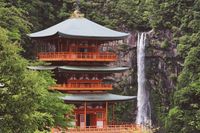
Seigantoji Temple
This is a temple that was said to be built in the shape of a God, and is used as an observation deck. Its construction date is unknown. The object of worship is known as Nyoirin Kannon and is known as a world heritage site along with Kumano Hongu Taisha shrine. The main hall was reconstructed by Toyotomi Hideyoshi in 1590 and was also cherished by the Tokugawa family. Visitors can witness the exquisite contrast between the orange-red 3 storied pagoda and Nachi Falls, and is an essential photo spot to capture the harmony between Shinto and Buddhism.
Spot
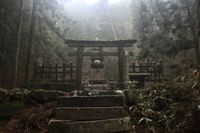
The Kumano Kodo Pilgrimage Routes
This place is a collective term for the pilgrimage road to the Kumano three shrines (Kumano Hongu Taisha、Kumano Hayatama Taisha、Kumano Nachi Taisha), and is registered as a World Heritage Site. The area is a natural place of worship where people from all walks of life, from the emperor and aristocrats, to ordinary people come to visit this area for worship. The area is also popular as a hiking destination.
Spot
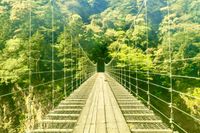
Dorokyo Gorge
This is a canyon upstream of the Kumano River. From the upstream, it is known as OkutoroKamitoroShimotoro, and the upper stream of the river is famously known as the "Doro Haccho". The valley offers spectacular geological views, where there are huge rock formations, strange rocky formations and seemingly endless cliff formations. The scenery from the 84 meter long suspension bridge "Yahiko Bridge" is a particular highlight.
Onsen
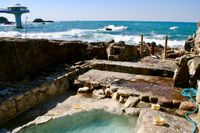
Shirahama Onsen
This is an old hot spring on the coast of Wakayama Prefecture. It boasts 1400 years of history, and various emperors such as Emperor KogyokuEmperor Jito and Emperor Monmu visited the place and is registered in the chronicles of Japan. It was loved by nobles and aristocrats as well as the regular people of the time, as it is today. It has plenty of facilities such as lodging, cooking areas, and camping areas. There are amazing views of the pacific ocean from the baths.
Spot
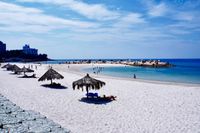
Shirara Beach
This is a sandy beach located in Namariyama bay in Wakayama prefecture. It is known as a white sandy beach whose sand is formed from quartz. It is a sister beach twinned with Waikiki beach in Hawaii, and being at this beach certainly gives a feeling of being in a tropical paradise. Many visitors come in summer to enjoy beach and water activities here.
Spot
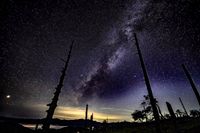
Odaigahara
This is a mountain plateau at an altitude of 1695 meters, on the border of Nara and Mie prefectures. It is a secluded area where you can see the spectacular views of the Milky Way, shining in a clear night sky. Stores, restaurants, accommodation facilities are also open close around the visitors' centre, and it is a popular place for astronomical observation.※Credit:Tsubasa Mizoguchihttp://bit.ly/2MI1vQs
Spot
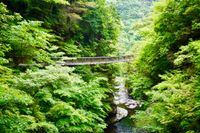
Mitarai Valley
A valley in Yoshino-gun, Nara prefecture. As the valley is quite deep there are various waterfalls, large and small, and visitors can see the brilliant green landscape that is largely untouched by humans. The greenery and autumn leaves are said to be the best in the Kinki region.
History
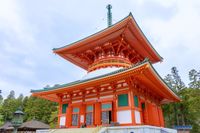
Kongobuji Temple
This is a mount Koya Shingon sect central temple built in 816 AD under the instruction of the great teacher and poet, Kukai. The main object of worship is known as Yakushi Nyorai, and it is registered as a World Heritage Site. This area is a sacred buddhist site located at the top of the mountain, with an altitude of 1000 meters, and around 100 temples are concentrated in this area. In the temples further into the area contain memorial towers to great figures such as Oda Nobunaga, Shinran, Date Masamune and others. One can also find the tombstone of Takeda Shingen here, as well as as as the mausoleum of Uesugi Kenshin, which is a building which also has the same function as a shrine.
History
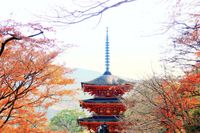
Hasedera Temple
This is a temple built by Domyo in 727 AD, and is the branch temple of the Shingon Buzan sect main temple. The object of faith is known as Juichimen Kannnon(11-faced) and is the head temple of the Hasedeta temple group, of which there are around 240 in Japan. As one of Japan's most prominent Kannon sacred sites in Japan, it attracted the faith and reverence of many aristocrats and nobles. Situated in the middle of Mount Hatsuse, in April and March, around 7000 Moutan Peony flowers of 150 varieties bloom in the area, which had led the temple to be also known as the "Flower temple".長谷寺 © w_0705_ クリエイティブコモンズライセンス(表示4.0 国際)https://creativecommons.org/licenses/by/4.0/